The allure of Komodo National Park, with its ancient reptilian inhabitants and vibrant underwater ecosystems, draws a specific clientele from Hong Kong seeking both adventure and exclusivity. The journey itself, however, presents distinct considerations for those accustomed to efficiency and luxury.
The Direct Advantage: Hong Kong to Komodo by Private Charter
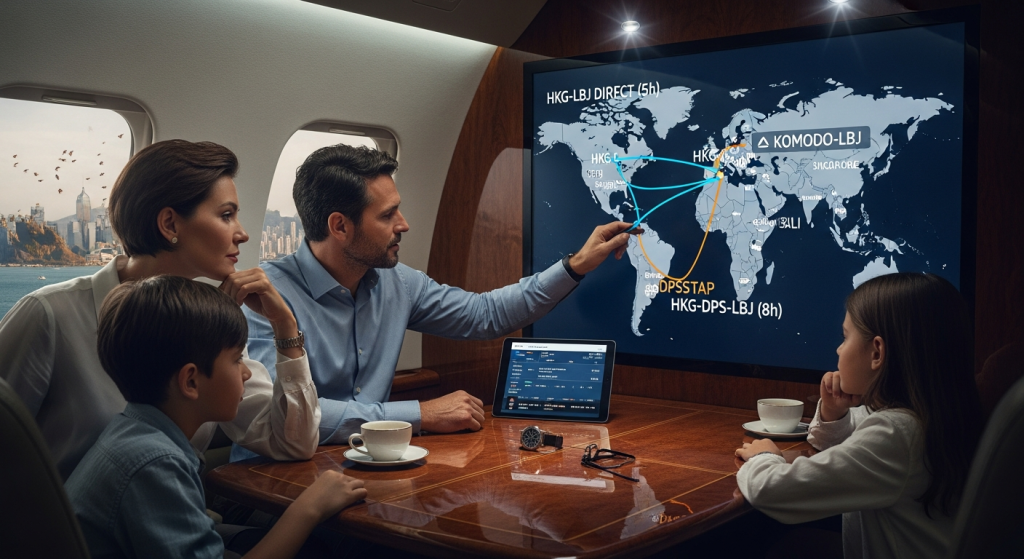
For the Hong Kong UHNW traveler, time is often the most valuable commodity. A direct private jet charter from Hong Kong International Airport (HKG) to Labuan Bajo Komodo Airport (LBJ) mitigates the complexities of commercial routing, reducing travel time to approximately 4.5 hours. This direct flight path, typically serviced by mid-size jets like a Cessna Citation Latitude or an Embraer Phenom 300, bypasses the need for multiple connections and lengthy layovers. These aircraft, often configured for 6-8 passengers, offer a cabin environment designed for productivity or relaxation, complete with satellite communication and bespoke catering. The total distance covered is around 2,000 nautical miles (3,700 kilometers).
The cost for such a direct charter typically ranges from USD 80,000 to USD 120,000 for a round trip, contingent on aircraft type and availability. This investment translates into an immediate time saving of 5-6 hours compared to commercial routes, a significant factor for finance-sector executives from Central or the IFC. Customs and immigration procedures are often expedited upon arrival at LBJ, managed discreetly by ground handlers, ensuring a seamless transition from aircraft to waiting land or marine transfers. Pilots operating these charters hold ATPL (Airline Transport Pilot License) certifications, requiring thousands of flight hours and rigorous recurrent training, ensuring the highest safety standards. This direct approach positions the Komodo experience not as a distant ambition, but as an immediate reality, allowing more time for diving at Manta Point or exploring Padar Island.
The Commercial Standard: Cathay Pacific & Bali Transit
The conventional commercial route from Hong Kong to Komodo involves a multi-leg journey, predominantly transiting through Bali. Travelers typically commence with a Cathay Pacific flight from Hong Kong International Airport (HKG) to Ngurah Rai International Airport (DPS) in Denpasar, Bali. This initial segment spans approximately 4.5 to 5 hours. Upon arrival in Bali, a transit period of 3 to 6 hours is common before connecting to a domestic flight to Labuan Bajo Komodo Airport (LBJ). Carriers such as Garuda Indonesia or Batik Air operate this 1.5-hour segment from DPS to LBJ.
The total travel duration for this commercial routing frequently extends to 8-10 hours, excluding ground transfers and unforeseen delays. Baggage handling can become a point of friction, particularly with transfers between international and domestic terminals in Bali, which are often physically separate. While Cathay Pacific maintains a high service standard, the subsequent domestic leg operates on a different scale. The average cost for a business class return ticket on Cathay Pacific to Bali, combined with an economy domestic connection to Labuan Bajo, typically ranges from USD 1,500 to USD 3,000 per person. Travelers often opt for an overnight stay in Bali to break the journey, incurring additional hotel expenses and further extending the overall travel time. This route, while more accessible financially, demands a greater investment of time and tolerance for logistical variances.
Beyond Bali: Sorong & The Eastern Gateway
For travelers whose itineraries extend beyond Komodo to include the remote wonders of Raja Ampat, an alternative, albeit more circuitous, commercial routing sometimes comes into consideration via Sorong. This option is not a direct route to Komodo but a strategic choice for multi-destination Indonesian voyages. The journey from Hong Kong would typically involve HKG to DPS (Bali), then a domestic flight from DPS to Makassar (UPG), followed by another domestic leg from Makassar to Sorong (SOQ). From Sorong, onward travel to Labuan Bajo (LBJ) would require yet another connection, often via Makassar or direct charter, adding significant complexity.
This extended routing can push total travel times beyond 12-16 hours, making it less practical for a standalone Komodo trip. The primary advantage of routing through Sorong is its proximity to Raja Ampat, a premier dive destination located in West Papua, approximately 1,600 kilometers east of Labuan Bajo. For those combining a Komodo liveaboard with a Raja Ampat expedition, the Sorong gateway becomes a logistical hub. However, for exclusive Komodo trips, the increased flight segments and potential for extended layovers at airports like Sultan Hasanuddin International Airport (UPG) in Makassar typically make this a less favorable option compared to direct private charter or the Bali transit. Data from Indonesian aviation authorities indicates over 700 domestic flights per day across Indonesia, highlighting the vastness of the network but also the potential for complex connections.
The Phinisi Liveaboard Connection: Direct to the Water
Regardless of the chosen flight path, the ultimate destination for Komodo expeditions is Labuan Bajo, the bustling port town on Flores Island. From Labuan Bajo Komodo Airport (LBJ), the transition to the marine environment is swift. For private jet arrivals, ground transfers are typically pre-arranged, whisking travelers directly from the tarmac to the harbor where bespoke phinisi liveaboards await. This seamless connection ensures minimal downtime between air travel and the commencement of the Komodo National Park experience. A typical transfer from LBJ airport to the main harbor takes approximately 10-15 minutes by car.
Phinisi vessels, traditionally crafted wooden schooners, represent the epitome of luxury exploration in the Komodo archipelago. Originating from the Bugis and Makassar ethnic groups of South Sulawesi, these ships are renowned for their distinctive twin masts and seven sails. The craftsmanship of Pinisi boatbuilding was recognized by UNESCO in 2017 as an Intangible Cultural Heritage of Humanity (unesco.org). Operators like Amanwana or Sequoia offer bespoke phinisi experiences, providing expert dive masters and gourmet dining. Arriving directly at the harbor and stepping onto a pre-arranged liveaboard means the Komodo adventure begins immediately, with the possibility of sailing towards iconic locations like Pink Beach or Padar Island within hours of landing.
Cost-Benefit Matrix: Time, Comfort, and Investment
Evaluating the Hong Kong to Komodo journey involves weighing financial investment against the invaluable commodities of time and comfort. For Hong Kong’s finance-sector executives, whose hourly value can exceed USD 1,000, the opportunity cost of an 8-10 hour commercial journey versus a 4.5-hour private charter is substantial. A private jet, while incurring a higher upfront cost (USD 80,000 – 120,000 round trip), delivers nearly double the efficiency in travel time. This allows for an extended Komodo itinerary or minimizes disruption to critical business schedules. Many UHNW individuals conduct an average of 4-6 international business trips annually, where time optimization is paramount.
Commercial flights, conversely, offer a significantly lower financial barrier (USD 1,500 – 3,000 per person), but introduce variables such as fixed schedules, potential delays, and the inherent discomfort of multiple transits and public terminals. The experience of navigating Ngurah Rai International Airport (DPS) during peak tourist season can be a stark contrast to the private FBO (Fixed-Base Operator) experience. For families from Hong Kong seeking a Komodo dive bucket-list trip, the commercial route might be a more accessible entry point, provided they are prepared for the longer travel duration and logistical management. However, the private charter ensures a higher degree of privacy, personalized service, and direct control over the travel itinerary, directly aligning with the expectations of luxury concierge clients.
Logistical Precision: Customs, Immigration, and Transfers
The ground experience upon arrival in Indonesia varies significantly between private and commercial travel. For private jet passengers arriving at Labuan Bajo Komodo Airport (LBJ), customs and immigration procedures are often streamlined and handled with minimal direct involvement from the traveler. Manifests are submitted in advance, and officials typically process clearances either on board the aircraft or in a dedicated private lounge, ensuring privacy and speed. Indonesia offers visa-free entry for citizens of over 70 countries for stays up to 30 days, simplifying entry requirements for many Hong Kong passport holders (indonesia.travel).
Commercial arrivals at Ngurah Rai International Airport (DPS) in Bali, and subsequently at LBJ, involve standard queues for visa-on-arrival (if applicable) and immigration processing. While efficient, these processes can take 30-60 minutes depending on passenger volume. Baggage claim, especially after multiple flight segments, can add further delays. Once cleared, commercial travelers typically navigate public terminals to arrange ground transportation to their hotels or the harbor. For private charter clients, pre-arranged luxury vehicles or direct harbor transfers are standard, ensuring a seamless continuation of the journey. The difference is one of efficiency and discretion, with private travel designed to minimize friction points and maximize the immediate enjoyment of the Komodo experience.
For those planning a bespoke journey to Komodo National Park, understanding these logistical nuances is key to crafting the ideal travel experience. Whether prioritizing ultimate speed and privacy or balancing cost with adventure, the journey from Hong Kong to Komodo is an expedition in itself. Discover more about tailoring your exclusive Komodo adventure and direct travel options at hongkongtokomodo.com.